Mon – Sat 08:30–18:30 · Production in Konya, Turkey
 Industrial
Chiller Manufacturer
IndustrialContinuous blast freezing on a spiral belt: high product flow in a small footprint.
A spiral freezer is a continuous blast freezer that freezes products with cold air while carrying them on a belt that winds up or down in a spiral. Wrapping the belt in a spiral fits a long freezing path into a small floor area. That is why it is placed at the end of a production line to freeze products continuously without manual handling. Öztek Soğutma manufactures spiral freezers complete, including the enclosure, the belt and the refrigeration system.
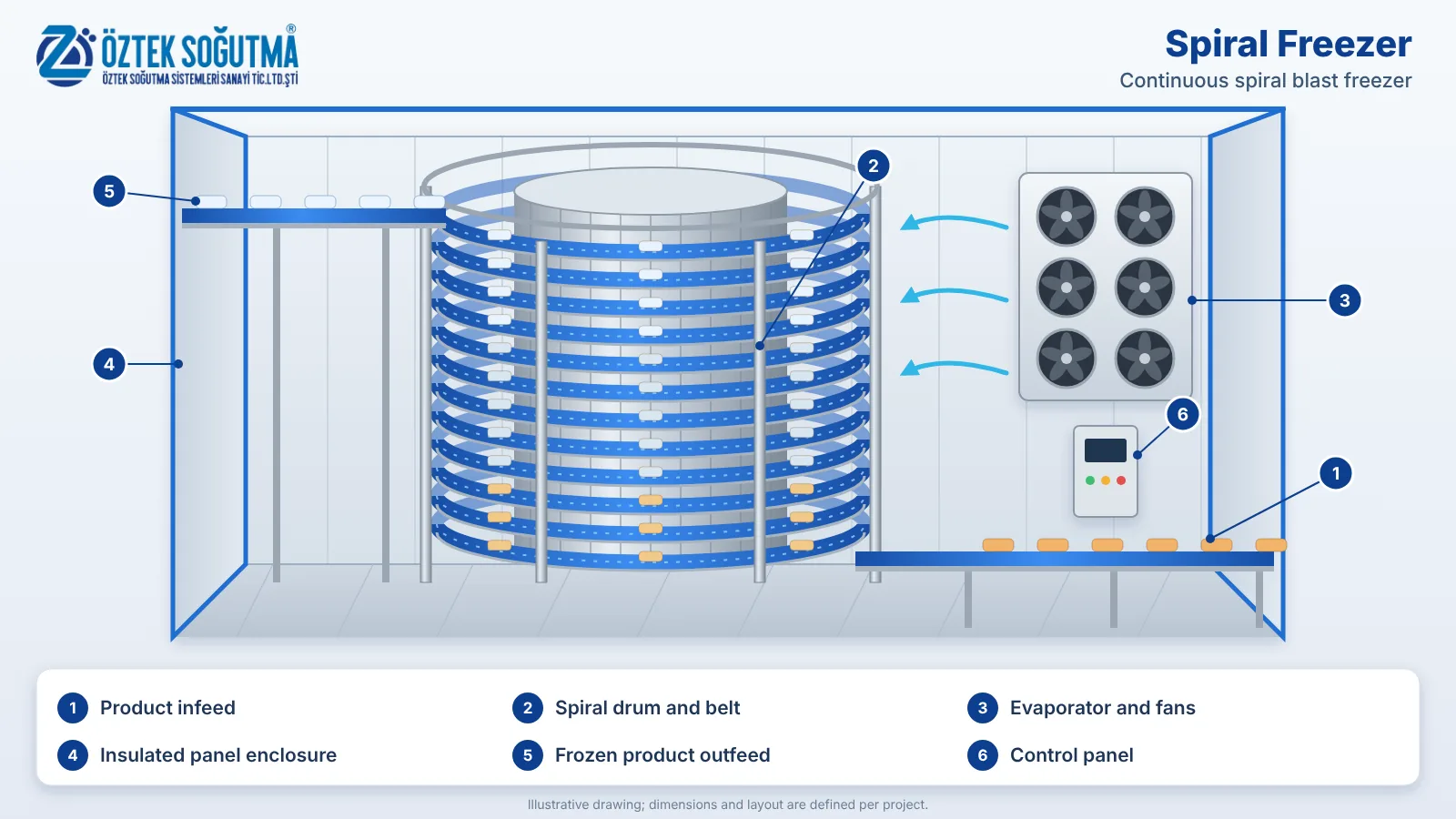
Products move from the line conveyor onto the belt wound around the spiral drum. As the belt turns inside an insulated enclosure and carries products slowly up or down, cold air from the evaporators is directed between the product tiers. The belt speed sets the dwell time, in other words the freezing time, for each product. Frozen products leave the outlet and go straight to the packaging line.
Each spiral freezer is designed for the product it will freeze: product type and size, inlet and target temperature, hourly throughput, belt width, number of tiers and plant layout are assessed together. On the refrigeration side, the compressor rack, evaporator layout, defrost method and controls are selected from this data. See our compressor racks page, and the conveyor tunnel freezer page for the straight-belt alternative.
All spiral systems work on the same principle: the product travels a long path on a belt wound around a drum. What differs is how far the product is cooled and how the drum is configured.
Freezes the product quickly with sub-zero air. The aim is to bring the core temperature below the freezing zone in a short time, preserving quality and preparing the product for frozen storage.
A spiral cooler does not freeze; it chills the product above zero. It is used to bring baked, cooked or heat-treated products to the required temperature before packing, slicing or the next process. Cabin temperature and air velocity are set to cool the product without drying it or causing surface condensation.
Designed for bread, bagels, cakes, cooked meat products and ready meals leaving the oven or cooking line at high temperature. Packing a hot product causes condensation and mould risk inside the pack; sending it straight into a freezer needlessly increases the freezer load. A hot product spiral cooler handles this intermediate step in a controlled, hygienic way, and freezing can follow in a spiral freezer if needed.

In single drum systems the belt winds around one drum; the product enters at one level and leaves at another. It takes little space and fits easily into the line layout. Where a longer retention time is needed or infeed and outfeed should be at the same level, multi-drum configurations are considered. Number of drums, belt width and number of tiers are set according to the product, capacity and available floor space.
Blast freezing moves the product quickly through the freezing zone. Fast freezing forms smaller ice crystals inside the product, giving better texture, lower drip loss and better taste after thawing. Typical spiral freezer applications:
For plants that freeze on trolleys or racks, a blast freezing tunnel may suit better; for products moving on a straight line, a belt freezing tunnel.
A spiral belt is used not only for freezing and cooling but also to lift the product from one level to another, to buffer it between lines and for processes where the product must stay in a controlled environment for a set time. The floor space a long straight conveyor would need is used vertically instead.
A modular plastic belt is made of interlocking food-grade plastic modules. A damaged section can be repaired without replacing the whole belt, the surface is easy to wash and it can run on straight lines, curves and spiral systems. Modular plastic belt or stainless steel wire belt is chosen according to the product type, temperature and hygiene needs.
A mechanical spiral freezer works with air cooled by a compressor-based refrigeration system and evaporators. In cryogenic systems, liquid nitrogen or carbon dioxide is injected directly into the enclosure. Cryogenic systems may need a lower initial investment, but the gas consumed is a continuous operating cost. For long, high-capacity production, mechanical systems are usually preferred. The spiral freezer described on this page uses a compressor-based (mechanical) refrigeration system.
Even freezing on every tier depends on cold air being distributed evenly across the belt tiers. Air can be directed vertically along the drum or horizontally between the tiers. If air velocity and direction are not set correctly, the product may freeze unevenly between lower and upper tiers, dry out on the surface and lose weight. Fan positions and air ducts are therefore designed for the product.
Moisture from the product and air entering through the infeed and outfeed openings builds up as ice on the evaporators, reducing airflow and refrigeration capacity. Defrosting can be done with hot gas, water or electric heaters. In long shifts, staggered defrost — thawing the evaporators one after another — lets production continue without stopping. Correctly sized openings and, where needed, dehumidification reduce the ice load.
Stainless steel and food-grade plastics are used on food-contact surfaces. A sloped floor and drainage stop wash water from collecting in the enclosure. Belt washing systems clean the belt automatically during production or between shifts; drying the belt after washing should also be planned. Easy access for cleaning also makes food safety audits easier.
The spiral freezer is managed by a PLC-based control system. Belt speed (the product’s retention time), enclosure temperature, fan speeds and the defrost programme are set from it. Saved product recipes speed up product changeovers. Temperature logs, alarms and remote monitoring support both product quality and fast response to faults.
The refrigerant is chosen according to plant size, existing refrigeration infrastructure and local regulations. Stand-alone systems can use HFC/HFO compressor packs, while large plants may use central ammonia or CO₂ systems. If the plant already has a central refrigeration system, the spiral freezer can be designed to connect to it.
In a tunnel freezer the product moves along a straight line, so a long retention time requires a long tunnel. A spiral freezer winds the same path around a drum and fits it into a much smaller footprint. It stands out for products needing long freezing times and for plants with limited space.
Both use the same spiral belt structure. A spiral cooler chills the product above zero, while a spiral freezer freezes it below zero. Their refrigeration capacity, cabin insulation and defrost needs therefore differ.
For freezing applications the air temperature in the enclosure is usually kept between -30 °C and -40 °C, and the target is generally to bring the product core to -18 °C or below. Exact values depend on the product, its thickness and the project.
Capacity is defined as the amount of product frozen per hour (kg/h). Product weight and size, infeed and target outfeed temperature and the required freezing time together determine the belt area, number of tiers and refrigeration capacity.
IQF (individually quick frozen) means freezing pieces quickly and separately so they do not stick together. When products are placed on the belt without touching, a spiral freezer freezes them individually. For very small products that tend to stick, such as peas or sweetcorn, fluidised-bed freezers may be more suitable.
The most common industrial types are the trolley or rack blast freezing tunnel, the belt freezing tunnel, the spiral freezer, the plate freezer and the fluidised-bed freezer. Cryogenic freezers using nitrogen or CO₂ form a separate group. The choice depends on product type, capacity and available space.
Bu sitede ziyaret istatistikleri ve reklam ölçümü için çerezler kullanılır. Ayrıntılar