Mon – Sat 08:30–18:30 · Production in Konya, Turkey
 Industrial
Chiller Manufacturer
IndustrialHow a chiller works, its types and parts, capacity calculation and selection.
What is a chiller? In short, a chiller is a cooling machine that chills a liquid such as water or water-glycol and sends it through a closed circuit to machines, moulds, tanks or air-conditioning units. The liquid picks up heat at the point of use, returns to the chiller and is cooled again. This guide explains how a chiller works, the main types and parts, how capacity is calculated and what to check when choosing one.
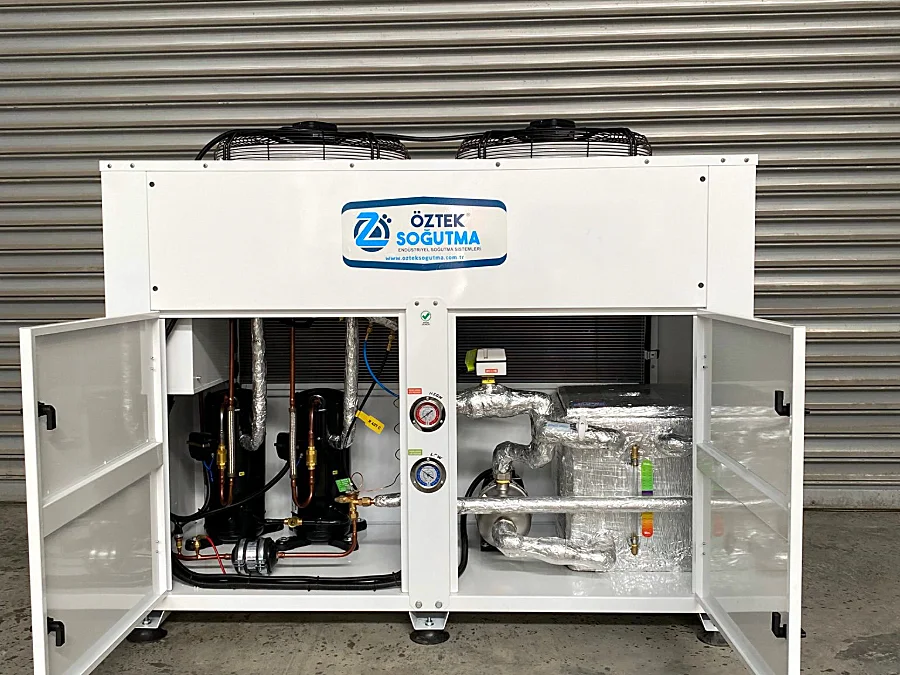
A vapour-compression refrigeration cycle runs inside the chiller. In the evaporator the refrigerant evaporates and absorbs heat from the water. The compressor raises the pressure and temperature of this vapour. In the condenser the refrigerant rejects its heat to air or water and condenses. The expansion valve lowers the pressure and the refrigerant returns to the evaporator. On the water side a pump sends the chilled water to the consumers and the warmed water comes back. See how a chiller works for the full cycle.
Air-cooled chillers reject heat to outdoor air through fans and a finned condenser; they need no extra water circuit and are easy to install. Water-cooled chillers reject heat to water from a cooling tower or dry cooler; they are more compact and efficient at large capacities. We compare them in air-cooled vs water-cooled chillers.
Scroll compressors are used at small and medium capacities; semi-hermetic reciprocating and screw compressors at medium and large capacities. See chiller compressor types.
No. A cooling tower cools water by evaporation and can only bring it close to the outdoor wet-bulb temperature. A chiller uses a refrigeration cycle to cool water to the required temperature regardless of the weather, even below zero. With water-cooled chillers a tower or dry cooler is used together with the chiller to reject condenser heat.
The refrigerants used in the cycle are covered in refrigerant types.
Plastics and metalworking, food and beverage, chemicals and pharmaceuticals, printing, laser cutting, hydraulic oil cooling, data centres and building air conditioning are the most common applications.
For water the practical formula is: Capacity (kW) = 1.163 × water flow (m³/h) × temperature difference (°C). For example, cooling 10 m³/h of water by 5 °C needs about 58 kW. Capacity is corrected for glycol and for high ambient temperatures. Step by step: chiller capacity calculation.
Chiller efficiency is expressed by EER and COP, the kW of cooling produced per kW of electricity (what are EER and COP). In cold climates free cooling switches the compressors off when outdoor air is cold enough and saves significant energy (free cooling).
Condenser cleaning, filter checks and monitoring the water and glycol ratio extend chiller life. Dirty water blocks the heat exchanger; low flow and wrong settings can freeze the evaporator. See chiller water quality, evaporator freezing and chiller noise.
The price depends mainly on cooling capacity, required water temperature, air- or water-cooled design, number of compressors and options such as an integrated pump, buffer tank or free cooling. A reliable quote needs these data first.
With regular maintenance, industrial chillers often reach a service life of 15 years or more. Clean condensers, a correct refrigerant charge and good water quality are the deciding factors.
Not always. A buffer tank is useful when the water volume in the system is small or the load changes quickly, because it prevents frequent compressor starts.
No. An air conditioner cools air directly. A chiller cools water or a water-glycol mixture, which is then pumped to machines, processes or fan coil units.
Öztek Soğutma designs and manufactures industrial chillers at its plant in Konya, Türkiye: catalogue models from 12 kW to 330 kW and project-specific units above that. See our products for models and technical data, or contact us for a chiller suited to your project.
Bu sitede ziyaret istatistikleri ve reklam ölçümü için çerezler kullanılır. Ayrıntılar